Showing posts with label Philippa Gregory. Show all posts

Tuesday, May 19, 2009

The Constant Princess, Philippa Gregory

Book Review: I've noticed of late that I have had a little bit of trouble getting into the feel and rhythm of Gregory's books. I can't say what it is, perhaps the author's style has become slightly monotonous  for my tastes, but this does not take away from the fact that Gregory's books are as brilliant as they ever were!

In fact, The Constant Princess is one of the most beautifully written of all her works! Fictionally detailing the life and reign of Queen Katherine of Aragon, the first of Henry VIII's six wives, this book brings to the reader's mind this most noble of his wives. She was indeed a true princess through and through, to her death she held herself as the true queen of England and would not give ground to her usurpers.  In fact in her last
 letter to Henry, in the last stage of her life, she signs her name as 'Katherine the Queen'. 

Born to two of the greatest monarchs in Christendom, Ferdinand of Aragon & Isabella of Castile, she came to England a child bride to the then Crown Prince, Henry VII's son Arthur. As history would have it, Arthur died a mere six months after their wedding leaving Katherine a widow at 17.  She was then betrothed to Henry, the younger son who was six years her junior. And the rest as they say is history!

Gregory carefully takes her reader through the early life of Catalina, Infanta of Spain; we get a glimpse of her life with her parents as they are on campaign against the Moors. The reader gets an entrance into the sweeping grandeur of the conquered palaces, where Catalina spends most of her childhood within the walls of the
 now Spanish occupied harems.

From this lazy, feminine background the Infanta and Princess of Wales emerges to the male dominated, politically charged shores of 16th century England. Henry VII has claimed the crown from the blood-drenched battlefields and presents to Catalina the stock of royalty, the image of the vulgar commoner. We watch as she holds to herself as a true princess of the blood and seems to gleam among the rough horse-stock of England's dubious monarchy.

Gregory lends an almost Sheherzadean quality to the relationship between Arthur and Catalina, where she regales and entrances him with tales from far-off lands, tales of conquests and conquered, her Isabella's legendary fearlessness, her hero-worship of her father, her life in Spanish conquered Moorish palaces, and more!

We are taken through Catalina's first marriage, to her second with young Henry and her life with him; through it all we watch as she grows from a young, defiant girl to a woman in love, a woman who comes to the height of her expectations, a woman who grows to learn the strings of the English court, a woman who learns to hold her tongue and flatter, a woman who goes through the sorrow of one lost child after another, a woman who reconciles her child's worship of her parents with the reality of them, and a woman who to her dying day knew where her place in life stood.

This is indeed a book that endears an otherwise lost historical figure to the hearts of her readers. Definitely worth reading!

Book Synopsis: As youngest daughter to the Spanish monarchs and crusaders King Ferdinand and Queen Isabella, Catalina, princess of Wales and of Spain, was promised to the English Prince Arthur when she was three. She leaves Spain at 15 to fulfill her destiny as queen of England, where she finds true love with Arthur (after some initial sourness) as they plot the future of their kingdom together. Arthur dies young, however, leaving Catalina a widow and ineligible for the throne. Before his death, he extracts a promise from his wife to marry his younger brother Henry in order to become queen anyway, have children and rule as they had planned, a situation that can only be if Catalina denies that Arthur was ever her lover. Gregory's latest (after Earthly Joys) compellingly dramatizes how Catalina uses her faith, her cunning and her utter belief in destiny to reclaim her rightful title. By alternating tight third-person narration with Catalina's unguarded thoughts and gripping dialogue, the author presents a thorough, sympathetic portrait of her heroine and her transformation into Queen Katherine. Gregory's skill for creating suspense pulls the reader along despite the historical novel's foregone conclusion. 
Synopsis Copyright © Reed Business Information, a division of Reed Elsevier Inc. All rights reserved. Courtesy of Amazon.com

For more information or to purchase: http://www.amazon.com/Constant-Princess-Boleyn-Philippa-Gregory/dp/074327248X

Monday, May 11, 2009

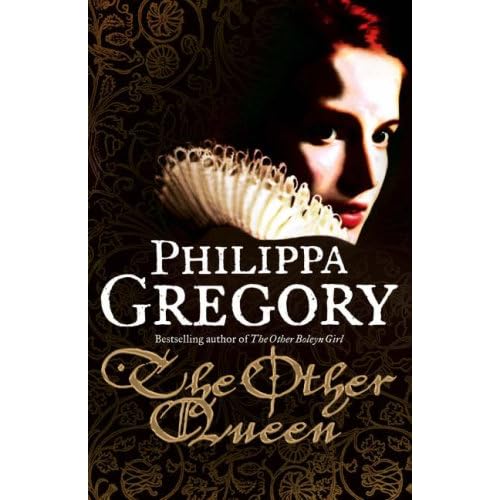
The Other Queen, Philippa Gregory


Book Review: To be honest I was highly disappointed in this book. The story deals with the capture and imprisonment of Mary, Queen of Scots by then Queen of England, Elizabeth I. The tale is indeed a long one recited by three personalities: George Talbot, Earl of Shrewsbury, his wife Bess of Hardwick and Mary. The narration is in these three voices, and carry the weight of their personalities, circumstances and lives. Gregory does indeed create believeable characters in them and a facinating narration of this most dramatic period in English history. However, in my reading of this book, I found her sole most facinating character to be "indomitable" Bess. George Talbot comes across as a snivelling weakling who can't hold two thoughts together! Mary comes across as a scheming harpie who carries herself less like a queen except in the eyes of her admirer, George who is primarily wooed by her striking beauty. In spite of her orchestration of an unsuccessful uprising, her constant attempts at escape, and his ultimate financial ruin; the man is apparently so besotted with her beauty and queenly carriage that he is helpless to save himself. Perhaps this is the story Gregory wishes to paint of this lackluster, real-life character but it would have been a much stronger storyline had the man seemed to have more of a brain in his head!


Mary is painted as a woman who besides constantly pining dramatically, constantly harps on her right to be queen, her assumed entitlement to three crowns, her son as an afterthought, her sickness, her beauty...etc., etc., etc. Fickle and weak but with a nasty streak of cunning, she seems to depend wholely on her misguided and desperate knights in shining armor...! After a while, that got old!


Bess is the one character in this book that has complexity and depth; a more...finished...personality than the other two put together. Halfway through I started skipping pages and just read Bess's narrations. In fact, she starts the book and she ends it. She does however constantly wax on and on about her prowess as a gold-digging, social climber. But as tedious and long as her monologues on her self-worth and her self-made fortunes are, she is less uninteresting than the other two characters.


Perhaps Gregory meant this novel to portray Bess as the leading character, and perhaps in this she achieved what she aimed for; but the utter failure in my opinion, of her other two characters to carry as much weight in the narration causes the reader to be more bored than bound by the progression of the storyline.


Overall, if you are loyal to Gregory you will at least get through this book!


Book Synopsis:Using the multiple-viewpoint technique that worked well in The Boleyn Inheritance (2006), Gregory fictionalizes a little-explored episode in the life of Mary, Queen of Scots. In 1568, after fleeing rebellious Scottish lords, Mary is placed into the custody of George Talbot, Earl of Shrewsbury, and his wife, Bess of Hardwick. This turns their Derbyshire estate into a hotbed of intrigue and possible treason. George, normally loyal to a fault, falls in love with Mary; Bess secretly reports to William Cecil, Queen Elizabeth’s spymaster, while fretting about her foolish husband and the continual draining of their funds; Mary plays them against one another while plotting to escape, with Cecil noting her every move. Gregory skillfully evokes the suspenseful atmosphere—it was never certain that the 1569 Rising of the North in favor of Catholic Mary would fail—but the protagonists’ inner thoughts, as presented in short alternating chapters, are unnecessarily repetitive. Although this isn’t her best work, Gregory’s writing is sharpest toward the end, as the unavoidable consequences of Mary’s long imprisonment are finally felt by all. --Sarah Johnson --This text refers to the Hardcover edition. Synopsis Courtesy of Amazon.com

Friday, May 01, 2009

The Queen's Fool: A Novel, Philippa Gregory

Book Review: I love Philippa Gregory! Anything she puts her pen to is a must-read! However, the Queen's Fool seemed a little...jaded. Although the plots were timeless, the characters classic, and the bakcgrounds vibrantly historic it wanted for ...oomph!

I did manage to get through it inspite of being conflicted between continuing to the finish line and just giving up.

If you are a loyal Gregory fan, then you will get through to the finish!

Book Synopsis: After winning the Parker Romantic Novel of the Year in 2002 for the brilliant The Other Boleyn Girl, Philippa Gregory returns to the Tudor court in this equally absorbing novel. It is 1553, Henry VIII is dead and his young son Edward is now king. 14-year-old Hannah Green, a determined Jewish girl with the gift of foresight, has come to England with her bookseller father to escape the Inquisition in Spain. After a chance meeting with the dashing Lord Robert Dudley at her father's bookshop, Hannah finds a new life as a court fool - and a spy. Reporting to Dudley all that happens around the sickly king, Hannah is also sent to spy on Princess Mary, with whom she strikes up a loyal and lasting friendship. When Edward dies, Hannah finds herself directly involved in the plots and schemes that abound at court as Mary comes to the throne, and struggles with her loyalty to the queen and subsequently to her sister Elizabeth. She wrestles with her sexual awakening, her love for Dudley and her betrothal to her cousin, Daniel, but ultimately cannot fight the male-dominant world she lives in as with her gift of foresight she is constantly manipulated by the powerful men around her for their own ends. Will Hannah be able to survive in a time of treachery, bloodshed and burnings, where her own religious beliefs could be questioned at any time? Unlike the many authors who concentrate on the times of Henry VIII or Elizabeth I, Philippa Gregory has turned her attention to the tumultuous period between the two reigns and takes us from the death of Edward VI up to Elizabeth's ascension with an assured historical touch. We see behind the pomp of the Tudor Court and into the minds of Mary and Elizabeth, rivals for the throne like their mothers before them. This is a powerful and moving tale of an important period in history, seen through the eyes of a young woman who is both observer and player in these tempestuous times. (Kirkus UK) Courtesy of Amazon.com